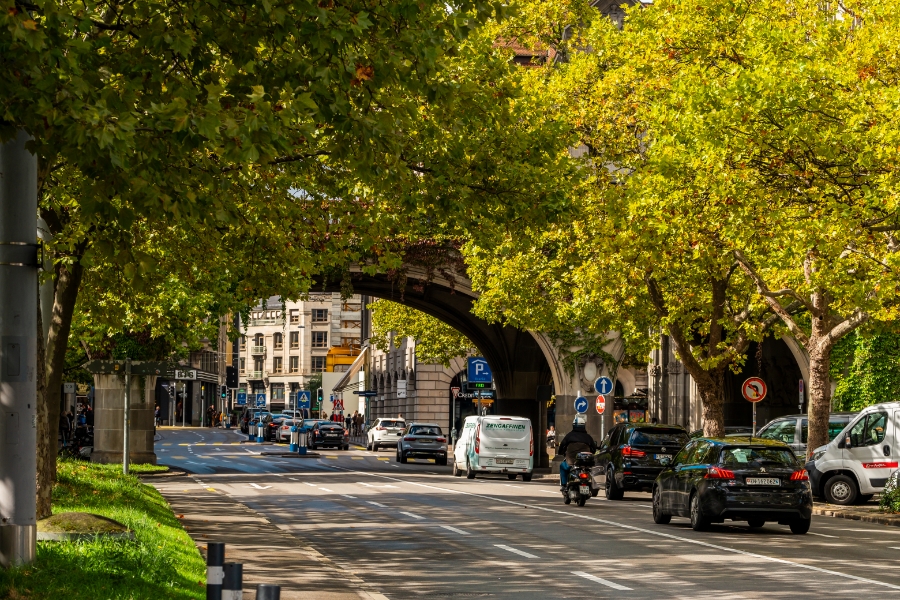
Driving in Zurich is legal and can be convenient, but you need to watch for trams and road signs. Trams generally have priority, while speed limits and access restrictions vary by street. If you're planning to book a Zurich car rental, it helps to understand where you can drive and leave your car. Our guide explains tram priority, speed limits, parking rules, and restricted streets before you set off.
Zurich has busy tram routes, marked cycle lanes, and junctions where several types of traffic meet. Knowing who has priority is important when you're new to the city.
Trams generally have priority over cars, including at junctions where tracks cross your lane. When driving in Zurich, give trams enough space before turning or moving across the rails. Never enter a junction if traffic ahead could leave you stopped on the tracks.
Watch the signals carefully. Trams use separate lights and signals at junctions. Follow the lights intended for your lane, not a signal facing the tram. At green lights, still watch for people crossing your turn and trams moving through the junction.
Check where passengers board and leave before passing a stopped tram. Some stops have a raised platform called a refuge island, which separates passengers from moving cars. You may pass a stopped tram on its right when there is a refuge island, but only slowly and when safe.
At stops without a refuge island, passengers may step directly onto the road. Stop until passengers have cleared the road. Swiss law permits passing a stopped tram only on the left in this situation, provided you can do so legally and safely. If you're unsure, wait behind the tram.
For moving trams, you normally overtake on the right. Left-side overtaking is permitted only under specific conditions, including when you cannot overtake on the right.
The default urban speed limit is 50 kilometres per hour, but many residential streets in Zurich have a 30-kilometre-per-hour limit. Always follow the posted speed signs, as limits can vary by street. In a Begegnungszone, or shared street, the limit is 20 kilometres per hour. Pedestrians have priority throughout these shared areas, and you may park only in designated spaces.
At zebra crossings without traffic lights, slow down and give way to pedestrians waiting to cross. At signal-controlled crossings, obey your light, but watch for people legally crossing the road as you turn. Check both sides before moving, even when the road ahead looks clear.
Swiss junctions generally follow priority from the right unless signs, traffic lights, or road markings set another order. Stop completely at a stop sign, and give way at an inverted triangle. Speed cameras operate throughout the city.
Follow the lane arrows as you approach junctions. Use turn-only lanes only for the marked direction. Do not cross solid lines or enter a bus-only lane unless signs or markings specifically permit your movement.
Check your mirrors and blind spots before turning across a cycle lane. Cyclists may be coming up behind you, especially when you turn right. Give cyclists room to pass and follow any cycle signals or priority markings. Never stop or park in cycle lanes.
If cars are queueing beyond the junction, remain behind the line until you can cross completely. Also watch for traffic signs when driving in Switzerland, since local lanes and limits can differ.
When driving in Zurich, carry your valid driving licence and rental documents. If your licence uses non-Latin characters, bring an International Driving Permit or official translation alongside your original.
Keep your daytime running lights on during the day and switch to dipped headlights at night, in tunnels, or in rain, snow, or fog. Everyone in the car must wear a seat belt. Children under 12 who are shorter than 150 centimetres need an approved child seat or booster.
Switzerland's general drink-driving limit is 0.05% blood alcohol, while learner drivers, probationary licence holders, and certain professional drivers face a stricter 0.01% limit. Driving at or above the applicable limit is prohibited. Your car must also carry a warning triangle. A high-visibility vest and first-aid kit are recommended but are not compulsory for ordinary cars.
Before motorway travel, check for a valid sticker or electronic vignette. The annual vignette costs CHF 40, and driving without one brings a fine. Confirm your third-party liability cover and other insurance conditions before leaving the pick-up point.

Parking can take planning because painted lines and signs determine where you can stop. Read the sign before leaving, even if other cars are parked there.
Zurich's blue parking zones require a physical blue parking disc displayed clearly behind the windscreen. Set the arrow to the next 30-minute mark after arriving. For example, arriving at 9:05 A.M. means setting the disc to 9:30 A.M. You must then leave by 10:30 A.M.
From Monday to Saturday, the standard parking limit is 1 hour from the time shown on your disc. If you arrive between 11:30 A.M. and 1:30 P.M., you can stay until 2:30 P.M. Arriving between 6:00 P.M. and 8:00 A.M. generally means you can park until 9:00 A.M. If you park after 7:00 P.M. and leave before 8:00 A.M., you don't need to display a disc.
Sundays and public holidays are generally unrestricted unless signs indicate otherwise. However, certain blue zones near Zurich Zoo have special restrictions on Sundays and public holidays. Electronic parking discs are not accepted, and you cannot reset your disc without moving your car back into traffic. Always check nearby signs before parking.
White-lined spaces in central Zurich are usually for paid, short-term parking. Look for a nearby metre or zone sign showing when charges apply and the maximum stay. Some machines take card payments, while supported mobile payment options link the session to your registration plate.
Enter the correct registration number and zone, and confirm your payment. Digital payments may not produce a printed ticket. Paying does not override the time limit. If the sign permits 2 hours, you must leave within 2 hours.
For longer daytime parking, you can buy a blue-zone day permit, valid for one calendar day. Online permits are linked to your car's registration number, so you don't need to print them. However, temporary parking restrictions still apply, and a permit doesn't guarantee a space.
Zurich's District 1 (postcode 8001) has no blue-zone parking spaces, so you cannot use the permit there. For overnight parking, check when the parking disc restrictions restart the next morning. If you're staying several days, ask your hotel about parking or consider a garage.
For the Old Town, choose a garage before arriving instead of searching through narrow streets. Central options include City Parking at Gessnerallee, the Urania car park, and the Hauptbahnhof garage near Zurich's main station. Around Bellevue and the lake, the Opéra and Feldegg car parks are alternatives, depending on your destination.
Zurich's electronic parking signs can show available spaces and guide you towards larger garages. Check height limits, overnight access, and charges before entering. For longer visits, you can park at a designated park-and-ride site outside the centre.
Never stop in a no-stopping area, including places marked by a blue circular sign with a red cross. A sign with a single red slash generally means no parking, although brief stopping may be permitted where safe. Yellow markings can identify prohibited stopping areas or spaces reserved for specific users, so follow the signs exactly.
Parking fines commonly start at CHF 40, depending on the offence. More serious obstructions can lead to towing. With a rental car, administration charges may apply in addition to the fine. Traffic fines and processing fees are among the extra car hire charges in Zurich worth checking before you book.
Verify parking tickets and pay through official instructions. Avoid unexpected payment links, and contact the rental company if anything looks suspicious.
You can book a car rental with Final Rentals and choose a compact car or an SUV for extra luggage. Selected Swiss bookings include Collision Damage Waiver, Theft Waiver, and Third-Party Liability cover, subject to the excess and exclusions.
Zurich's Old Town includes pedestrian areas, one-way streets, and access routes that change by time of day. If you’re driving in Zurich, a street that looks clear may not mean cars can enter.

Parts of Niederdorf and the historic streets on both sides of the Limmat are pedestrian zones. The signs may say Fussgängerzone for pedestrian zone or Einfahrt verboten for no entry. Obey the sign at the entrance, even if there is no gate or barrier.
Some Old Town pedestrian zones restrict private cars from noon until 5:00 A.M. the next day. Certain authorised trips are exceptions. Other streets have different rules, including exceptions for residents and authorised deliveries.
Avoid assuming that an entire named street has the same restrictions. Major roads such as Rämistrasse run alongside restricted areas, while smaller adjoining streets may be pedestrian-only. Choose a legal parking destination before you approach the Old Town.
Private cars cannot use Langstrasse between Brauerstrasse and Dienerstrasse from 5:30 A.M. to 10:00 P.M. Buses, bicycles, and taxis are exempt. Cars can use that section between 10:00 P.M. and 5:30 A.M., subject to posted signs.
During the day, use the signed alternative through Ankerstrasse and Kanonengasse. Check restrictions at each junction, as access can change due to roadworks and local traffic measures. Some nearby streets also have directional or time-based restrictions, especially around nightlife areas. If navigation leads towards a signed ban, follow a legal route instead.
Look for Einbahnstrasse signs indicating one-way traffic. Around Bahnhofstrasse, Stauffacher, and the Old Town, nearby roads may have different turn and access rules. Obey no-left-turn and no-right-turn signs even when your navigation suggests otherwise.
When driving in Zurich, set your destination to a garage entrance, not a street address inside a pedestrian zone. Navigation directions can lag behind changed restrictions. Some garages have entrances on a different street from their listed address. If you miss a turn, continue until you can change direction legally. Avoid reversing through busy lanes or making a sudden U-turn near tram tracks.
Before driving in Zurich, consider how each destination fits into your day's plans, especially if you're visiting the lakeside or continuing towards nearby towns outside the city. Two nearby attractions may require a longer drive because of the city's street layout. Group your stops by neighbourhood instead of crossing the centre several times.
Rent a car in Zurich with Final Rentals to enjoy unlimited mileage when your plans continue beyond the city. Your Zurich car rental may also include breakdown assistance for covered incidents, subject to the booking terms. Book and manage your car rental anytime. Download the Final Rentals app on Google Play and the App Store.
Restricted streets in Zurich are roads where private cars cannot enter, either all day or during signed hours. Parts of Niederdorf and Limmatquai have pedestrian restrictions. A section of Langstrasse bans private cars from 5:30 A.M. to 10:00 P.M. Read signs for exceptions, and ask your hotel before attempting a permitted luggage drop-off.
Blue-zone parking in Zurich requires a physical disc showing your arrival time, rounded up to the next half-hour. Standard limits apply Monday to Saturday, with an afternoon break and later departure times for certain arrivals. Sundays are generally unrestricted, although some areas near the zoo have extra rules. Central postcode 8001 has no blue-zone spaces.
Most Swiss road rules are national, but Zurich has many tram crossings, one-way streets, and time-based entry bans. Trams generally have priority, and cars must follow their own traffic lights rather than tram signals. Blue-zone parking and paid spaces also have local rules. Before turning or parking, follow the signs at your exact location.